Unifying checkout to recover revenue and enable future optimization
I built embedded shopping cart infrastructure into the main brand site to eliminate a conversion-killing redirect. Matched with the unified data layer built previously, the company would now have its first comprehensive and accurate view into cart-abandonment events. This marked an end to untraceable cross-channel journeys and estimate-based Pixel tracking metrics.
Digital and physical product purchases were handled on different sites
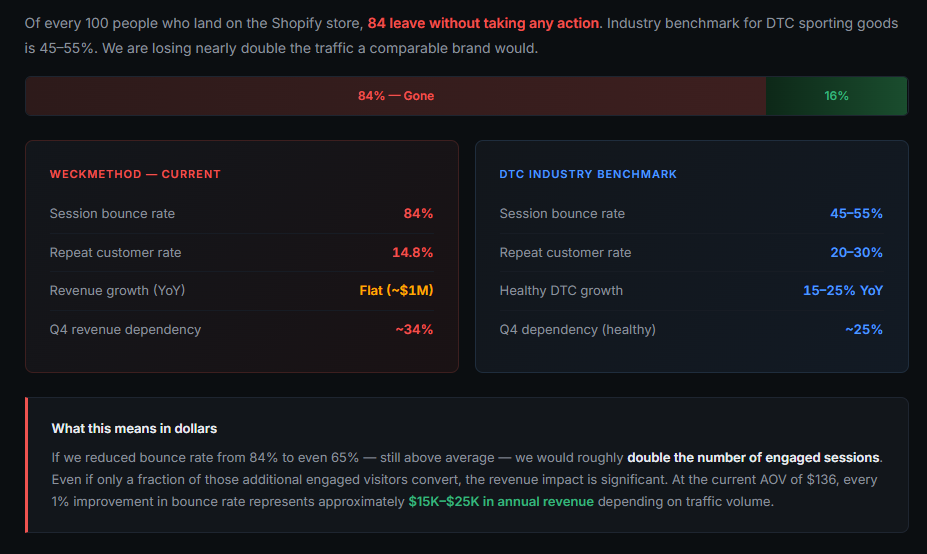
WeckMethod's main website, where users browse products, purchase and watch digital courses, and learn about the methodology, is a Rails application. To purchase physical equipment, customers were redirected from the brand site to a separate Shopify storefront. This introduced an entirely new domain with a different UI, navigation, and visual language. I had long speculated this cumbersome step was a major contributor to the company's 84% staggering 84% cart-abandonment rate that pushed far beyond industry peers, and warranted an immediate fix that was never prioritized.
The premium brand experience gave way to a jarring and disconnected Shopify redirect that invited drop-offs. The two platforms' analytics existing separately also prevented visibility into where users were abandoning the checkout process altogether.
Forced platform bifurcation created architecture complications + lost revenue
- Rails site handles only digital course transactions only one single-item purchase per transaction
- Customers sent from Rails channel to Shopify just to purchase physical equipment
- User session analytics rendered untrackable across platforms without server-side attribution
- Rails development too costly, driving company perpetually further into Shopify ecosystem unwillingly
- Required 2x design labor and dependencies to recreate brand experience across both channels
Forced platform bifurcation created evident friction, frustration and lack of trust
- 84% cart abandonment rates demonstrated frustrations with multi-site checkout flow
- Customers often forced to sign-up/login on two platforms just to check out
- Brand trust forced into question unnecessarily with each session
Two steps forward
Leveraging my intimate familiarity with the Rails codebase and LLM-assisted code generation, I designed and engineered a production-ready shopping cart purchase flow unhindered by budget constraints. The brand design system and existing Shopify cart structure were mirrored seamlessly, with architecture decisions made to enable critical and aspirational features like bundled purchases once considered out of reach.
Critical data integration and aligned design
- Built a Cin7 API integration handling session management and inventory sync server-side
- Enabled multi-item purchase free of previous product-class limitations
- Designed cart UI CSS styles sourcing the main site's design system
- Full checkout flow without a domain redirect matching Shopify cart user-flow
- Consolidated analytics enabling full-funnel visibility in one place
- Enabled multi-item purchase free of previous product-class limitations
Results and outcomes
The embedded cart replacing an unnecessary URL redirect addressed both the conversion friction and the revenue-visibility gap simultaneously. The question of whether price was a limiting factor could now also be explored and tested with a sufficient level of variable isolation.
![[background image] image of landscaping office space for a landscaping service](https://cdn.prod.website-files.com/68312696c5081fe7d23d7f08/699f886e4e6b33497cf8f05a_SHOPPING%20CART-PRIMARY.png)
- Tool efficiency enabled filling critical UX gaps — Cost-efficient LLM workflows enabled provision of the familiar and expected shopping-cart purchase journey without the disorienting Shopify domain redirect.
- Uncovered cart-abandon data clarity — The company could now discern true foregone revenue through checkout abandonment, enabled via tracking sessions coherently using server-side attribution via APIs and comprehensive cross-platform analytics. broken out by cart value, email capture rate, recovery rate, and average days to recovery. This data could then be leveraged with targeted recovery campaigns on the rails platform that didn't exist before.
- Cross-platform entity matching — The abandoned checkout system ties into the same email-based identity resolution used in the analytics platform, meaning an abandoned Shopify cart can be linked to a known trainer or course student in the main platform.
Optimized leverage for scaling and roadmap ahead
Long-desired and roadmap features became possible with compressed complexity.
Multi-item purchasing opened countless new promotional opportunities
- The ability to purchase both digital courses and physical equipment on the primary channel opened opportunities to offer critical revenue-generating promotional deals like BOGO 50% digital courses, and discounts on bundling physical goods with multiple online programs that was impossible before.
Introducing shopping cart infrastructure solved registration complexity
- Multi-item purchasing being solved prior to planned rebuilding Online + Live Training registration prevented laborious non-technical patchwork solutions by simplifying the need to allow customized equipment selections at payment.
Rethinking product-relationship positioning
- Multi-item purchase allowed for reorienting user-interaction with overlapping product themes and allowed for discussions surrounding vehicle-like custom arrangements purpose-built for a customer's precise desired outcomes, with video programs to pair.
Long-tail scaling features for video marketplace pulled forward
- Recurring billing enablement as a new payment format meant launching the upcoming video marketplace platform and offering subscription plans much later in the future could now be considered immediately.
![[background image] image of landscaping office space for a landscaping service](https://cdn.prod.website-files.com/68312696c5081fe7d23d7f08/6999790876412ecc7d3be3cf_chrome_QB9K02LW0h.png)