Geopolitical Turmoil Exposing Repeated Decision Inefficiencies
I designed and built a 3-phase supply chain visibility platform with powerful operations enhancements from real-time PO tracking to landed cost analysis and AI-powered document extraction to give the company its first centralized view into inventory, manufacturing, and fulfillment. Data cleaned and consolidated.
A company with overseas manufacturing and zero supply chain visibility
WeckMethod manufactures fitness equipment overseas and sells through both its own site and retail channels. Before this project, there was no centralized way to address or view operational and financial realities in real-time without relying on multi-day lead times or e-mail chains. see the status of a purchase order, track a shipment, understand landed costs, or plan inventory around seasonal demand. Inventory decisions were made and managed subjectively, with memory and e-mail chains as the source.
This meant that every Black Friday, every new product launch, and every factory delay was managed reactively. There was no early warning system for critical stock, no historical cost data to negotiate against, and no way to see the full financial picture of a product from factory floor to customer doorstep.
Supply chain managed by isolated spreadsheet, and memory
A string of damaging events the company encountered in 2025 frustrated me to the point of action. I built this without being asked. It was clear to me nobody else was going to address or solve them.
- Data inaccuracies and slow lead-times — I watched my boss wait 2.5 months after the close of Q3 for an accurate PnL update while contracted marketing and finance departments argued over missing and inaccurate data with numerous unagreed upon value definitions. The board continued to ask why they needed to wait so long. I was fuming with frustration knowing the API integrations + LLM integration I already built months ago could solve this in a couple hours.
- Onset of export/import tariffs + constant volatility — Business conditions and clarity on prudent cash management were constantly in flux as tariffs shifted production costs day after day. This led to a complete shift in project prorities and a sense of complete disarray amongst the team.
- Forced overspend on costly air-freight — The cash-position was seriously jeopardized by unusually high R&D costs in 2025 combined with numerous emergency air-freight costs at peak tariff-inflated rates due to poor inventory management prior to tariff-onset rumors
Subjective decision-making + e-mail threads
- PO-tracking existed only in e-mail chains
- No visibility into shipments until they arrived in customs
- Landed costs (product + freight + customs + duties) unclear org-wide per SKU
- Little to no seasonal-demand planning or holiday sales historical cross-referencing
- Stock levels became "critical" after already too late
A centralized visual source of truth
- Real-time PO visual pipeline with status transitions
- Shipment tracking with ETAs and progress
- Full + accurate real-time landed-cost breakdown per SKU
- Regressive seasonal demand analysis for inventory planning + predictive insights
- Critical stock alerts with malleable thresholds
3-Phase supply chain platform
I sequenced the roadmap by urgency: Phase 1 addressed the lack of a central source of truth on operational and PO statuses. Phase 2 enabled financial planning frameworks the company never had. Phase 3 automated the manual bottleneck that was slowing everything down.
Core Dashboard
- 6 KPI cards (active POs, in-transit, critical stock, overdue, health score, PO value) + per-SKU inventory table
- PO pipeline visualization (Draft → Confirmed → Production → Shipped)
- Critical stock alerts (30/60/90/120 day thresholds) + dead stock identification (180+ days)
- Live shipment tracking with ETA
Financial & Lifecycle Analysis
- Landed cost tracker (product + freight + customs + duties)
- Cash flow overlay (payment schedule vs arrivals)
- Seasonal planning with demand multipliers
- Product lifecycle P&L with 5-phase labeling
- Cost variance monitoring by factory and SKU
AI + Documents
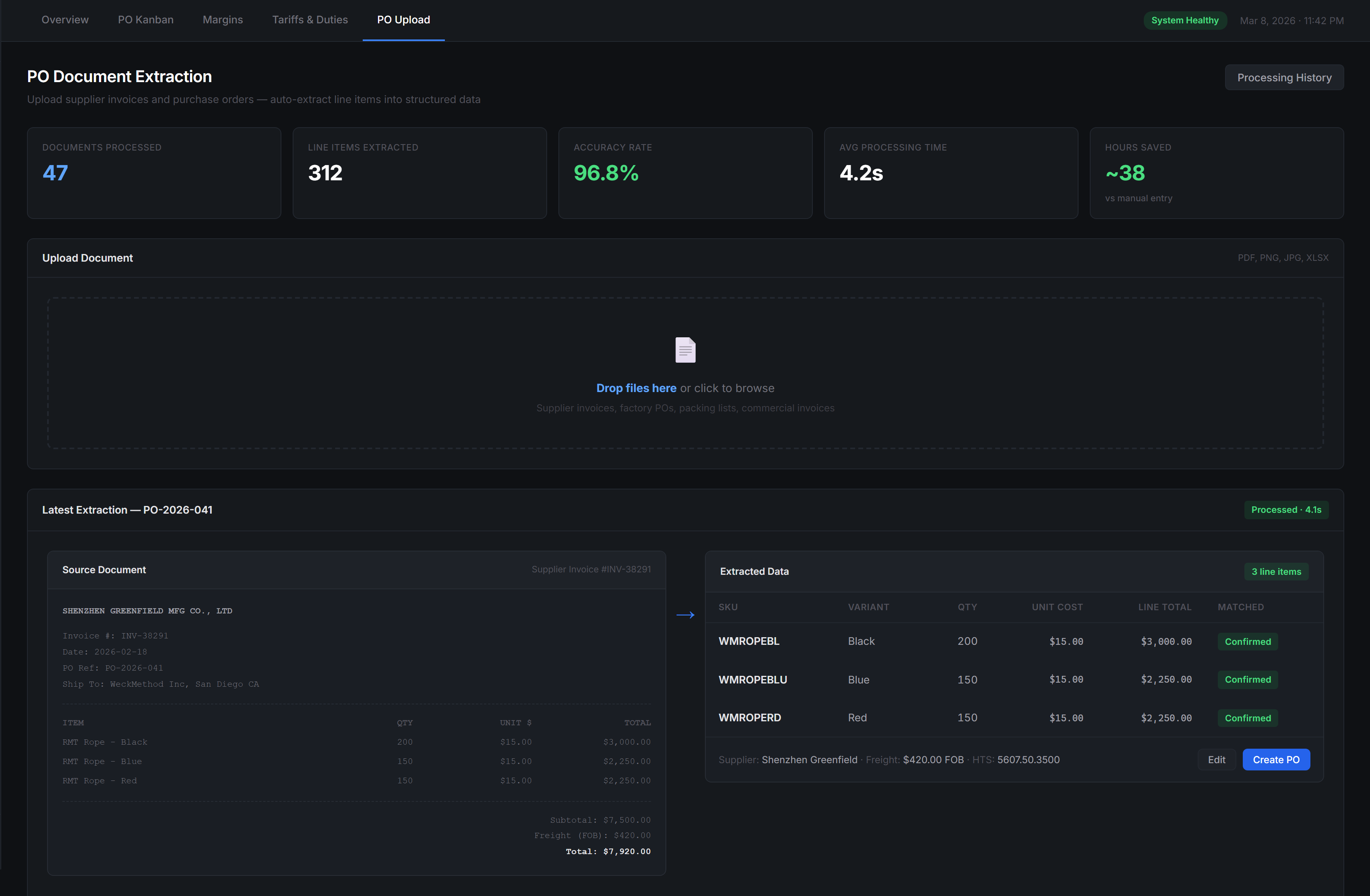
- Claude API extracts data from PO documents (PDFs, emails)
- Auto-classifies PO phase and updates records
- Margin analysis by SKU with profitability badges
- Duty & tariff tracker with HS codes
- Sourcing optimization recommendations
Key Technical Decisions
Lifecycle state machine for purchase orders
- Each PO moves through a defined state machine: Draft → Confirmed → Production → Ready → Shipped → Delivered. Every transition is timestamped and auditable. This makes the pipeline visualization possible and lets the system calculate lead times, detect overdue POs, and project delivery dates.
Claude API for PO document extraction and classification
- Supply chain documents (invoices, packing lists, commercial invoices) arrive as PDFs or email attachments with no standard format. The Claude API parses these documents, extracts structured data (line items, quantities, prices, HS codes), and auto-classifies the PO lifecycle phase. This turns what was a manual data-entry bottleneck into an automated ingestion pipeline.
Configurable alert thresholds instead of fixed rules
- Different products have different reorder lead-times. A product manufactured in China needs a 120-day threshold; a domestic product might need 30 days. The alert system provides optionality per SKU category rather than global rules, to ensure warnings are relevant.
![[background image] image of landscaping office space for a landscaping service](https://cdn.prod.website-files.com/68312696c5081fe7d23d7f08/69ae26253285f713bb5c0ee5_final-dashboard.png)
Results and outcomes
Emergency air-freight cost the business $60k alone in 2026 at 15% total COGS. Unnecessary missteps like stock-outs and overnight freight costs could be avoided with the power of accurately tuned foresight. This internal tooling allowed for data-driven decision making rooted in the confidence of full visibility, also acting as a primary contributor to accurate real-time PnL readings via single-origin clarity on landed-cost calculation. This was leveraged later in my NLQ application to produce accurate real-time PnL read-outs.
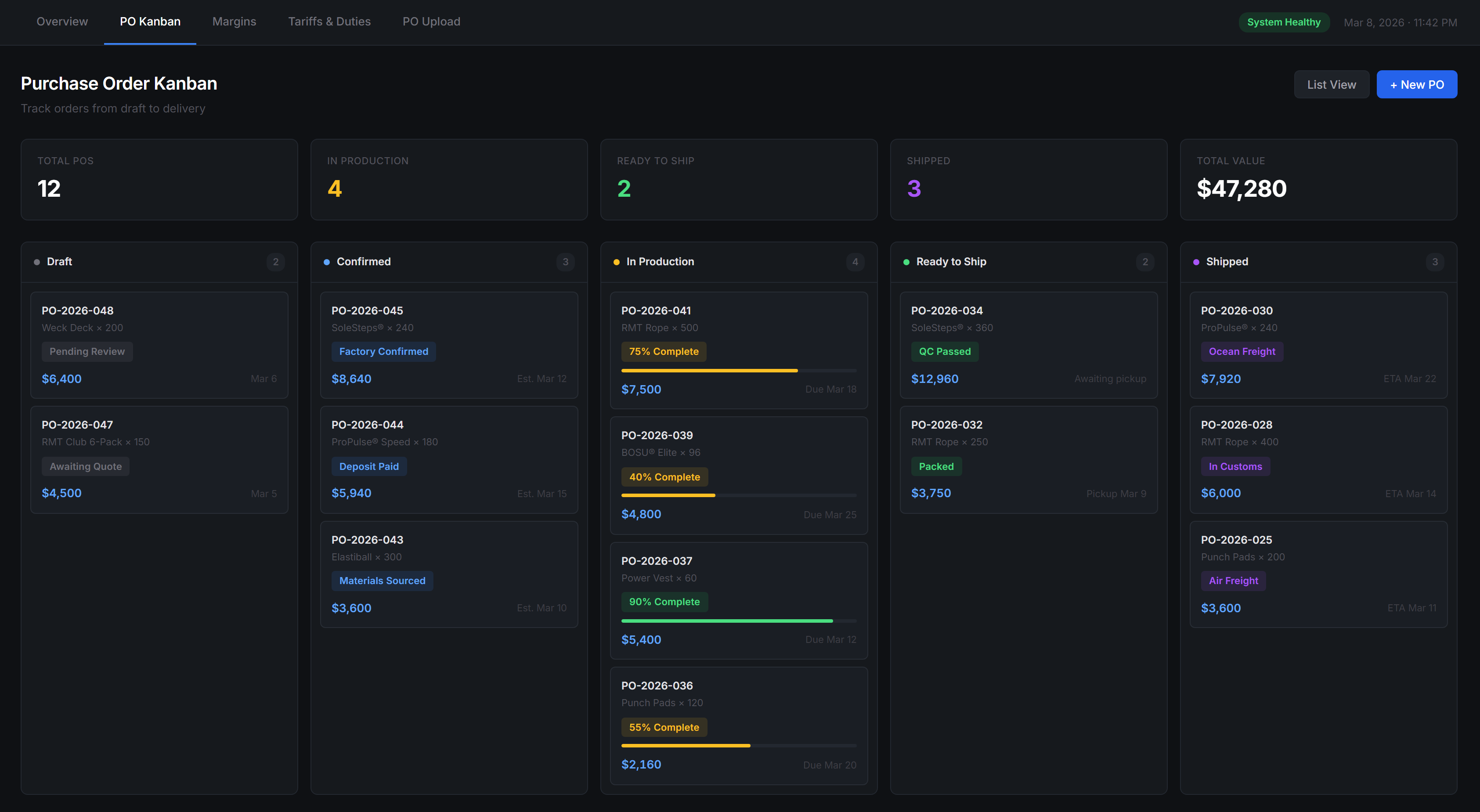
- First-time centralized supply-chain view — The operations team could visualize all active POs, in-transit shipments, and critical stock instances from a single dashboard, replacing email threads and memory for good.
- Proactive, data-driven decisions — Critical stock alerts fire before items sell out, not after. Seasonal demand multipliers (3x for Black Friday, 2.5x for 4th of July) within the forecasting logic backtested against previous years allow for due preparation in advance. This prevents rush-shipping overspending and decreases stock-outs.
- Full landed-cost visibility — For the first time, the company can see the true cost of a product including freight, customs, and duties , not just the factory price. This enables real margin analysis and informs pricing decisions.
- PO upload and automation — Prevents any possibility of human-error and status miscommunication